Tack för att du rapporterar den här kommentaren. Ångra
PRO
Greyge
Of the drawn options, I would favor the 180 × 120 cm soft oval. It keeps eight chair positions while the plan shows 1.3 m and 1 m front-to-back clearances, compared with 1.15 m and 0.75 m around the 160 cm round table. Its curved corners should also make the highlighted side pinch points feel less abrupt than those of a rectangle, while retaining much of a round table’s conversational quality.
A 150 cm round would be very tight for eight: it provides only about 59 cm of perimeter per person before accounting for how the chairs meet around the circle. The 160 cm round is more sociable, but its footprint presses harder on the passage in your drawing. The soft oval therefore looks like the best balance of capacity, circulation and visual lightness. I would mark out its full footprint on the floor and place eight chairs around it before committing, because the chair backs and occupied seats—not just the tabletop—will determine whether those side routes work comfortably.
Here's a sculptural dining table design from our GREYGE.com collection, just as a visual reference. KAI uses a rounded-square geometry and can be custom-sized, illustrating another middle ground between round sociability and rectangular capacity: https://www.greyge.com/product/kai-living-room-table/. Its capacity for eight is not documented, so it should not be treated as a proven fit for that requirement.
GillaSpara
Tack för att du rapporterar den här kommentaren. Ångra
PRO
Brianform & Stoneform
We make dining tables, many of them in natural stone, to custom sizes, so one detail on the 180 cm oval is worth checking before you order: "oval" covers very different shapes. A true ellipse narrows quickly towards the ends, so the two people sitting at the heads get a pointed, tight spot. A super ellipse (a softer rounded rectangle) or a racetrack shape with straight sides and half round ends keeps much more usable width at the ends, and at 180 x 120 cm with eight people that is what makes the end seats comfortable.
Second, look at the base as carefully as the top. With eight around the table, a central pedestal or two bases set well inside the edge leave every knee position free, while four legs near the rim of an oval always end up between two chairs.
And when you do the cardboard mock up, cut the exact shape you plan to order, not just a rectangle of the same length and width, and sit at the ends too.


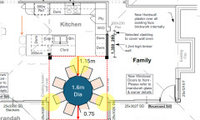

Of the drawn options, I would favor the 180 × 120 cm soft oval. It keeps eight chair positions while the plan shows 1.3 m and 1 m front-to-back clearances, compared with 1.15 m and 0.75 m around the 160 cm round table. Its curved corners should also make the highlighted side pinch points feel less abrupt than those of a rectangle, while retaining much of a round table’s conversational quality.
A 150 cm round would be very tight for eight: it provides only about 59 cm of perimeter per person before accounting for how the chairs meet around the circle. The 160 cm round is more sociable, but its footprint presses harder on the passage in your drawing. The soft oval therefore looks like the best balance of capacity, circulation and visual lightness. I would mark out its full footprint on the floor and place eight chairs around it before committing, because the chair backs and occupied seats—not just the tabletop—will determine whether those side routes work comfortably.
Here's a sculptural dining table design from our GREYGE.com collection, just as a visual reference. KAI uses a rounded-square geometry and can be custom-sized, illustrating another middle ground between round sociability and rectangular capacity: https://www.greyge.com/product/kai-living-room-table/. Its capacity for eight is not documented, so it should not be treated as a proven fit for that requirement.
We make dining tables, many of them in natural stone, to custom sizes, so one detail on the 180 cm oval is worth checking before you order: "oval" covers very different shapes. A true ellipse narrows quickly towards the ends, so the two people sitting at the heads get a pointed, tight spot. A super ellipse (a softer rounded rectangle) or a racetrack shape with straight sides and half round ends keeps much more usable width at the ends, and at 180 x 120 cm with eight people that is what makes the end seats comfortable.
Second, look at the base as carefully as the top. With eight around the table, a central pedestal or two bases set well inside the edge leave every knee position free, while four legs near the rim of an oval always end up between two chairs.
And when you do the cardboard mock up, cut the exact shape you plan to order, not just a rectangle of the same length and width, and sit at the ends too.
Brianform & Stoneform