
Circular Garden
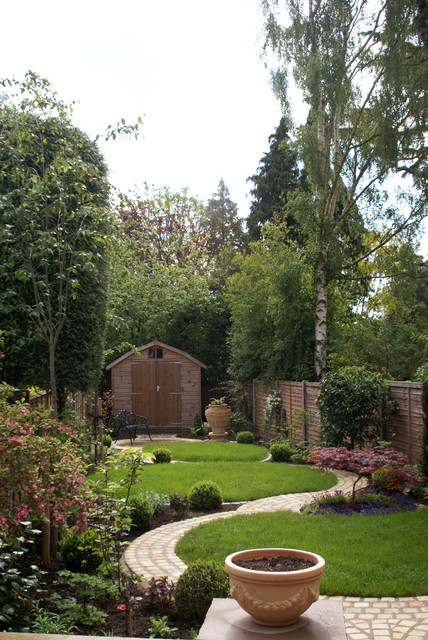
Our client’s garden was bereft of any interest, other than a large shed at the end of the garden, and a small patio outside the house. An unattractive stand of conifers dominated one side of the garden, and overpowered the space.
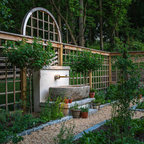
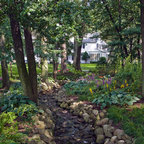
These two areas were linked using a bold design of interlinking circles, with a cobbled path snaking its’ way down the garden to create a feeling of greater width and depth. A dry stone wall sets off the patio, and frames the entrance into the main part of the garden.
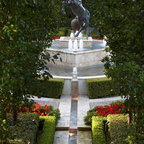
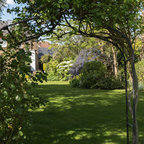
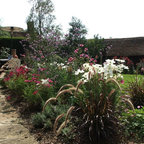
A feature pot is set on a plinth at the bottom end of the garden, where it is visible from the house. The planting is colourful and interesting, with box balls used to reinforce the circular theme. The conifers have been removed and replaced with attractive ornamental trees that will provide more year round interest
These two areas were linked using a bold design of interlinking circles, with a cobbled path snaking its’ way down the garden to create a feeling of greater width and depth. A dry stone wall sets off the patio, and frames the entrance into the main part of the garden.
A feature pot is set on a plinth at the bottom end of the garden, where it is visible from the house. The planting is colourful and interesting, with box balls used to reinforce the circular theme. The conifers have been removed and replaced with attractive ornamental trees that will provide more year round interest
Inspiration för en mellanstor rustik bakgård i delvis sol, med en trädgårdsgång och marksten i tegel — Houzz
Houzz-medlemmar har lämnat kommenterar om följande:

Evelyn Chan har lagt till detta i Evelyn's Outdoor ideas
Which material would you recommend?
“Treated wooden sheds are widely available and are generally the cheapest option,” Peter says. “However, if security is a concern, consider metal options, which can be securely locked and often come with methods of securely fixing them to the ground.
“If you’re looking for minimal maintenance and longevity,” he continues, “then sheds made from composite materials [such as a mix of wood, reusable polypropylene and weatherproof resin] are a good option.”
Aaron Priestman offers six types of timber cladding on his sheds, which are primarily designed for bicycle storage, from vertically fixed, untreated UK larch at the lower end of the price range, up to painted European, pressure-treated pine and western red cedar tongue-and-groove.
“Durability of all the options is high,” Aaron says, “especially if they’re treated biannually with a suitable preservative or oil. Often, the decision on cladding is aesthetic, so the choice is personal taste.”
Hazel Addison har lagt till detta i hazel111's Ideas
Winding path also accent pot (olive )