203 560 foton på hus
Sortera efter:
Budget
Sortera efter:Populärt i dag
41 - 60 av 203 560 foton

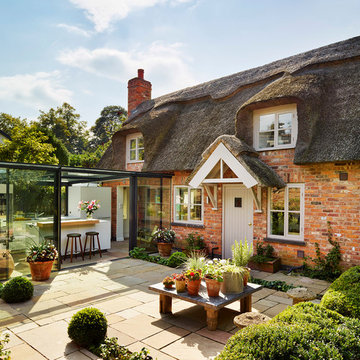
Refurbishment of 17th century Manor House including roof repairs, chimney replacement, internal alterations and extensions. The extensions follow the footprint of earlier ancillary buildings and use both reclaimed and new matching materials. Oak frame construction is employed throughout the extensions with exposed trusses providing height and visual interest. Large areas of glazing provide a link with the landscaped garden to the south, lacking in the original building.
Hitta den rätta lokala yrkespersonen för ditt projekt
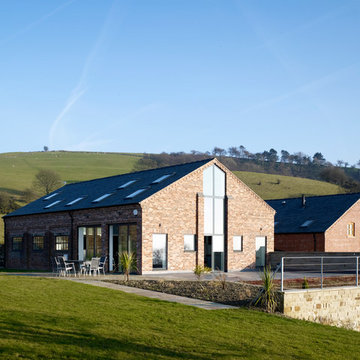
A south facing extension has been built to convert a derelict Grade II listed barn into a sustainable, contemporary and comfortable home that invites natural light into the living spaces with glass extension to barn.
Glovers Barn was a derelict 15th Century Grade II listed barn on the ‘Historic Buildings at Risk’ register in need of a complete barn renovation to transform it from a dark, constrained dwelling to an open, inviting and functional abode.
Stamos Yeoh Architects thoughtfully designed a rear south west glass extension to barn with 20mm minimal sightline slim framed sliding glass doors to maximise the natural light ingress into the home. The flush thresholds enable easy access between the kitchen and external living spaces connecting to the mature gardens.

Inspiration för mellanstora lantliga svarta hus, med två våningar, metallfasad, sadeltak och tak i metall

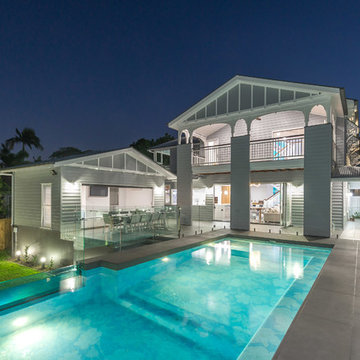
Faultless is how the judges described this beautiful home. Masterfully constructed with a layout designed to maximise the northern light and shield the outdoor areas from the weather. This home radiated class and elegance with excellent ambience and aesthetic throughout.

This split level contemporary design home is perfect for family and entertaining. Set on a generous 1800m2 landscaped section, boasting 4 bedrooms, a study, 2 bathrooms and a powder room, every detail of this architecturally designed home is finished to the highest standard. A fresh neutral palette connects the interior, with features including: baton ceilings and walls, American Oak entrance steps, double glazed windows and HRV Solar System. Families keen on entertaining enjoy the benefits of two living areas, a well appointed scullery and the al fresco dining area, complete with exterior fire.

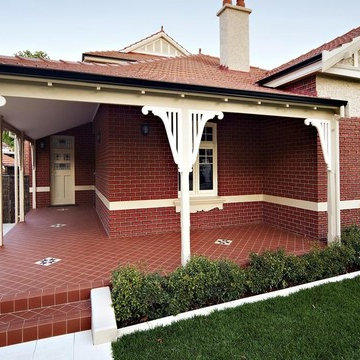
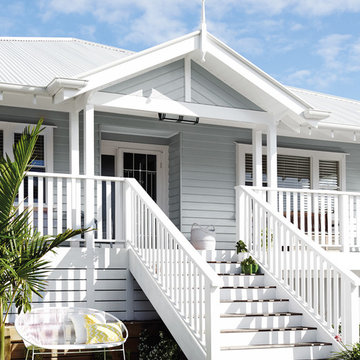
An extension and renovation to a timber bungalow built in the early 1900s in Shenton Park, Western Australia.
Budget $300,000 to $500,000.
The original house is characteristic of the suburb in which it is located, developed during the period 1900 to 1939. A Precinct Policy guides development, to preserve and enhance the established neighbourhood character of Shenton Park.
With south facing rear, one of the key aspects of the design was to separate the new living / kitchen space from the original house with a courtyard - to allow northern light to the main living spaces. The courtyard also provides cross ventilation and a great connection with the garden. This is a huge change from the original south facing kitchen and meals, which was not only very small, but quite dark and gloomy.
Another key design element was to increase the connection with the garden. Despite the beautiful backyard and leafy suburb, the original house was completely cut off from the garden. Now you can see the backyard the moment you step in the front door, and the courtyard breaks the journey as you move through the central corridor of the home to the new kitchen and living area. The entire interior of the home is light and bright.
The rear elevation is contemporary, and provides a definite contrast to the original house, but doesn't feel out of place. There is a connection in the architecture between the old and new - for example, in the scale, in the materials, in the pitch of the roof.

Recupero vecchio fienile per locale degustazioni di azianeda agricola che produce ortaggi biologici
Inredning av ett rustikt litet hus, med två våningar, tegel, sadeltak och tak i mixade material

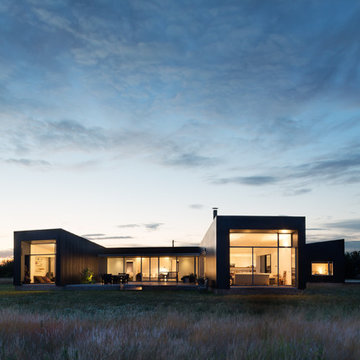
Distinct form and dark materiality juxtapose against the organic contours and vibrant colours of the landscape that it is encapsulated within.
– DGK Architects

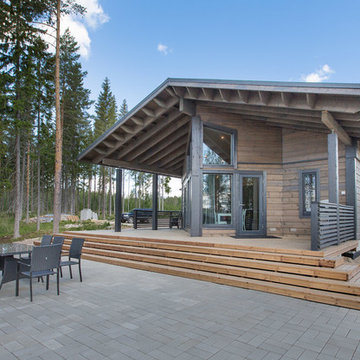
Au cœur de la presqu'île de Lège-Cap-Ferret, le projet profite d'une parcelle orientée est-ouest, en prise directe avec l'étendue du bassin d'Arcachon et ses berges arborées. Naturellement orientée vers ce paysage, la maison s'implante en fond de parcelle et constitue un jardin en interface avec cette vue exceptionnelle sur le bassin.
Un socle contemporain se dessine avec une vêture à claire-voie et de larges ensembles vitrés, tandis qu'une cabane traditionnelle avec de larges avant-toits vient se jucher au-dessus pour mieux scruter l'horizon.
Entièrement construite en bois, le projet respecte et réinvente la culture architecturale locale par son parti-pris volumétrique et ses détails constructifs.
Le parti-pris constructif en ossature bois associé aux compétences d'artisans locaux répond à la fois à l’engagement pour une architecture au bilan carbone minimum et à l'ambition d'un maintien des savoirs faire et d’un suivi possible et raisonné de la construction dans le temps.
Avec simplicité et en accord avec son contexte, l'orientation de la maison et ses espaces intérieurs sont pensés en adéquation avec les usages attendus et avec le climat local. Les larges avants toits ou encore la constitution d'espaces traversants propices à la ventilation naturelle assurent un rafraichissement constant et permettent de favoriser une vie quotidienne entre intérieur et extérieur.
Le projet est construit avec des murs à ossature bois, un solivage traditionnel pour le plancher d’étage et de la toiture terrasse, et une charpente industrielle pour la toiture haute en tuile.
Une dalle béton a été mis en œuvre en plancher bas et assure la remontée de la structure bois vis-à-vis du terrain naturel et la cote de nivellement imposée par le plan de prévention des risques submersion marine.
Le plan des réseaux a été optimisé pour éviter au maximum les habillages en second œuvre. La structure bois ou encore le solivage du plancher de l’étage se retrouvent ainsi visibles et participent de l’esthétique intérieure avec le parquet, l’escalier et la bibliothèque réalisé en chêne massif.
3